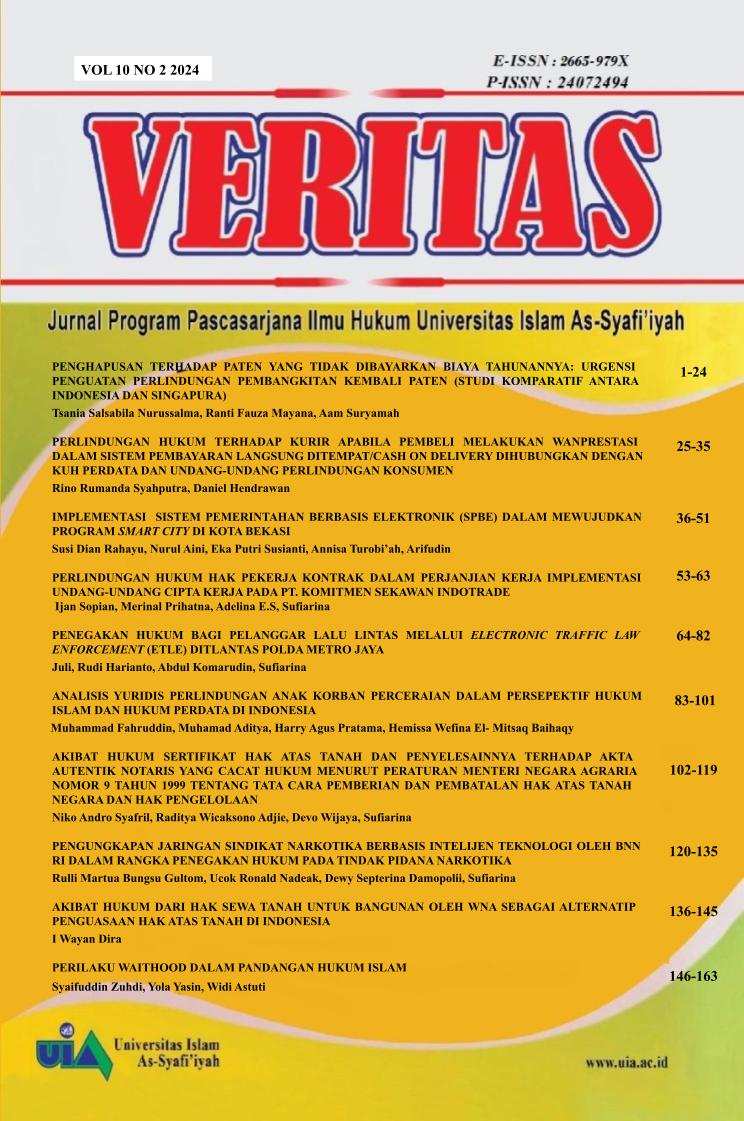
Penghapusan Terhadap Paten Yang Tidak Dibayarkan Biaya Tahunannya: Urgensi Penguatan Perlindungan Pembangkitan Kembali Paten (Studi Komparatif Antara Indonesia Dan Singapura)
DOI:
https://doi.org/10.34005/veritas.v10iNo%202.4014Keywords:
Patents, Patent Removal, Patent Restoration, Protection ReinforcementAbstract
Patent removal affected the degradation of patent innovation development in Indonesia, particularly domestic patents, is significantly below the country's targets. Hence, there is an urgent need for a legal framework that can comprehensively accommodate patent protection. The purpose of this research is to identify the loophole in Indonesian Patent regulations by analyzing the implementation of the constitutive protection system for reinstating patents that have been revoked due to non-payment of annual fees, based on a comparative legal analysis of patent policies in Indonesia and Singapore. The data collection techniques used in this research include a normative juridical method, supplemented not only by relevant legislation but also by field research in the form of interviews. The collected data is processed and analyzed qualitatively, with the findings presented descriptively. The research results indicate that Indonesia's patent cancellation policy, which is predominantly influenced by non-payment of annual fees, does not take into account whether the patent holder's failure to pay was intentional or not. Unfortunately, patents cannot be revived unless ruled otherwise by the court, and there are no clear exceptions, potentially hindering the achievement of targets for increasing domestic patent innovation. In contrast, in Singapore, patent holders can reinstate their patents if the non-payment of the renewal fee is proven unintentional under certain conditions, such as the exercise of reasonable care. Therefore, regulatory reforms on patent revocation and reinstatement are necessary to accommodate technological advancements in Indonesia.